
Find the data worth labeling.
Most captured data is redundant. Curate dedupes the repeats, mines the long tail, and sends labeling only the frames that add signal.
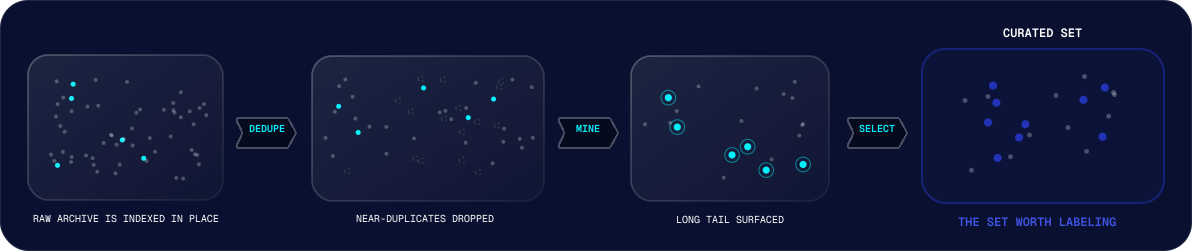
From raw capture to a curated set.
Curation is a search problem. Curate maps your data, separates the redundant from the rare, and narrows labeling to the frames the model actually needs.

Bring in the full captured dataset.
Drop near-duplicate and redundant frames.
Map every frame into a searchable feature space.
Surface rare scenarios and long-tail edge cases.
Pick the smallest set that covers what matters.
Search everything you captured.
Camera, LiDAR, radar, IMU and CAN logs, indexed in place and cut into scenario clips. Findable in plain language.
Point it at any dataset.
Curate runs on data from Collect or the capture you already have, in the formats your pipeline already speaks.
Features at a glance
Common questions about Curate.
Does Curate need labeled data first?+
What data and formats does Curate read?+
How does searching sensor data in plain language work?+
Where does Curate run, and does my data leave my environment?+
How is Curate priced?+
Label the data that matters.
Stop paying to label the same scene twice. Curate finds the smaller set that teaches the model more.